Who Wrote the Quran? How It Was Revealed, Written Down, and Compiled

Bright Quran Editorial Team
Authentic Islamic & Quranic Education
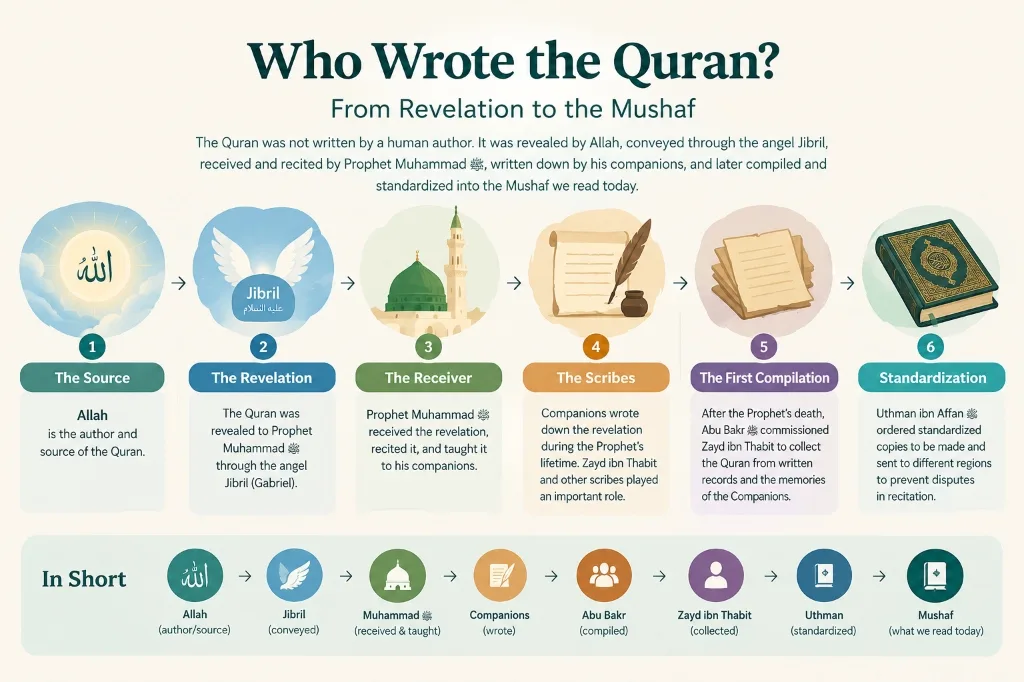
According to Islam, the Quran was not authored by a human being. Muslims believe it is the word of Allah, revealed to Prophet Muhammad ﷺ through the angel Jibril (Gabriel) عليه السلام.
That answer raises a second question: who actually wrote the revelations down, and how did they become the Mushaf (the written copy) that Muslims read today? In the traditional Islamic account, Companions of the Prophet ﷺ wrote down revelation during his lifetime, the written material was collected into one compilation under Abu Bakr رضي الله عنه, and standardized copies were produced under Uthman رضي الله عنه. None of them is regarded as an author. Their role was to record, collect, and copy what had been revealed.
This article follows that account step by step, drawing mainly on Sahih al-Bukhari. It presents the traditional Islamic understanding, which is a matter of faith for Muslims, and it labels historical and manuscript evidence separately where it appears.
Who Is the Author of the Quran According to Islam?
In Islamic belief, Allah is the source of the Quran. Muslims call it *Kalam Allah*, the speech of Allah. The Arabic word *wahy* means revelation, the way Allah communicated the Quran to the Prophet ﷺ.
Several different things are often blurred together when people ask "who wrote it?":
| Term | Meaning | Who, in the Islamic account |
|---|---|---|
| Authored / source | Whose words these are | Allah |
| Revealed | Sent down | Allah, through Jibril |
| Received | Taken in from the angel | Prophet Muhammad ﷺ |
| Recited / conveyed | Taught aloud to others | Prophet Muhammad ﷺ |
| Written down | Recorded on writing materials | Companions who served as scribes |
| Compiled | Collected into one written set | Under Abu Bakr, carried out by Zayd ibn Thabit |
| Standardized | Copied into uniform Mushafs | Under Uthman, by a committee |
According to Quran.com's overview, Muslims hold that the revelation came over about 23 years, beginning when the Prophet ﷺ was around forty, in about 610 CE. Muslim tradition places the end of revelation at his death in 632 CE.
Did Prophet Muhammad ﷺ Write the Quran?
No. Muslims do not regard Muhammad ﷺ as the author of the Quran. His role was to receive the revelation, recite it to his Companions, and teach it to them.
The Quran describes him with the Arabic word *ummi*. Many scholars understand this to mean "unlettered," and some also note that the word can refer to belonging to a people who had not received an earlier scripture. This article does not rest on either interpretation. The Islamic position does not depend on one word. It rests on the belief that the Quran came from Allah and was conveyed, not composed, by the Prophet ﷺ.
Was the Quran Written During the Prophet's Lifetime?
Yes, according to the traditional account. The Quran was not a book that first appeared after his death.
Revelation was recited, memorized, and also written down. The best-known evidence is in Sahih al-Bukhari 4986, where Abu Bakr reminds Zayd ibn Thabit رضي الله عنه that he used to write down the revelation for the Messenger of Allah ﷺ. Zayd was one important scribe among several.
What had not yet happened during the Prophet's lifetime, according to that same report, was gathering all the written material into one collection. The writing existed, but it was spread across different materials and in the memories of many Companions.
Who Were the Scribes of the Quran?
Scribes of revelation were Companions who wrote down the verses as they were revealed. Zayd ibn Thabit is the best-known example, and Sahih al-Bukhari 4986 names his role explicitly. Traditional biographical sources name other Companions as scribes too, including the four rightly guided caliphs, Abu Bakr, Umar, Uthman, and Ali, and Mu'awiyah ibn Abi Sufyan رضي الله عنهم. This is not a complete list.
The distinction matters: a scribe of revelation is not an author of the Quran. Scribes wrote down what the Prophet ﷺ recited. They did not compose it.
How Was the Quran Preserved?
In the traditional account, the Quran was preserved in two complementary ways:
- Memorization and oral recitation. Companions learned the Quran by heart and recited it, and this oral transmission preserved both its wording and its pronunciation.
- Written recording. Verses were written on materials available at the time. This provided an additional written record that could be checked against what the Companions had memorized.
Sahih al-Bukhari 4986 shows both at work. When Zayd collected the Quran under Abu Bakr, he gathered it from written pieces on palm stalks and thin white stones, and from men who knew it by heart. The two forms worked together: memorization supported accurate oral transmission, while written records provided an additional reference for the revealed text. Later accounts add that Zayd was careful in confirming each verse, but that detail comes from secondary sources and not from the Bukhari report itself.
Muslims also point to Surah Al-Hijr (15:9), in which Allah says He sent down the *Dhikr* (the Quran) and will guard it. This is how many Muslims understand the preservation of the Quran as a matter of faith, alongside the historical process described here.
Memorization remains central to how the Quran is transmitted today. For learners who want to follow that tradition, our Quran memorization resources can help structure revision.
Who First Compiled the Quran Into One Written Collection?
According to Sahih al-Bukhari 4986, it happened after the Prophet's death, in the time of Abu Bakr رضي الله عنه, the first caliph.
The sequence in the report is:
- The Battle of Yamamah. Many Companions who had memorized the Quran, known as *qurra*, were killed in battle against the false prophet Musaylimah.
- Umar's concern. Umar ibn al-Khattab رضي الله عنه feared that more reciters might die in future battles and that part of the Quran might be lost. He urged Abu Bakr to order that the Quran be collected.
- Hesitation. Abu Bakr first asked how they could do something the Messenger of Allah ﷺ had not done. Umar answered that it was a good thing and kept urging him until Abu Bakr agreed.
- Zayd's assignment. Abu Bakr then asked Zayd ibn Thabit to do the work, describing him as a young man who was intelligent, not suspected of anything, and who had written down revelation for the Prophet ﷺ. Zayd also hesitated at first, saying the task felt heavier than moving a mountain, before he accepted.
- The collecting. Zayd searched for the Quran in written materials such as palm stalks and thin white stones, and among men who knew it by heart. He reports finding the last verses of Surah At-Tawbah with Abu Khuzaymah al-Ansari and not with anyone else at that point.
- The result. A complete written set of sheets (*suhuf*) was produced.
To be precise: Abu Bakr did not write the Quran. He commissioned its collection into one written compilation. Zayd did not author it. He carried out the collecting.
What Happened to the Quran After Abu Bakr?
The sheets stayed with Abu Bakr until he died, then passed to Umar for the rest of his life, and then to Hafsah, Umar's daughter and a wife of the Prophet ﷺ.
So the chain of custody was Abu Bakr → Umar → Hafsah. The compiled sheets were later requested from Hafsah when Uthman commissioned standardized copies.
Why Did Uthman Standardize the Quran?
According to Sahih al-Bukhari 4987, the reason was the community's growth and differences in recitation.
- By Uthman's time as caliph, Muslims had spread far beyond Arabia. In the report, people from Syria and Iraq were fighting together in campaigns toward Armenia and Azerbaijan.
- Hudhayfah ibn al-Yaman رضي الله عنه was alarmed to see them differing in how they recited the Quran. He urged Uthman to act before the community began to dispute over the Book as earlier communities had.
- Uthman asked Hafsah to send the sheets, so that copies could be made and the sheets returned to her.
- He then instructed a committee to copy them into Mushafs: Zayd ibn Thabit, Abdullah ibn al-Zubayr, Sa'id ibn al-As, and Abd al-Rahman ibn al-Harith ibn Hisham.
- He told the three Qurashi members that if they disagreed with Zayd on any point, they should write it in the dialect of Quraysh, since the Quran was revealed in their tongue.
- When the copying was done, he returned the original sheets to Hafsah and sent a copy to each Muslim province.
This was not rewriting the Quran from scratch. The source describes copying the existing compiled sheets into uniform Mushafs, with the stated purpose of keeping the community united on one written form.
Why Did Uthman Order Other Written Copies to Be Burned?
This question comes up often, and the report itself is short. According to Sahih al-Bukhari 4987, after the standardized copies were sent out, Uthman ordered that all other Quranic materials, whether in fragments or complete copies, be burned.
The context given in the same report is the concern about disputes over recitation. The traditional understanding is that this was meant to prevent disagreement and confusion as the community expanded, by leaving one agreed written reference in every region.
Some points are worth keeping clear:
- The report describes the burning of other written Quranic materials after the standardized copies had been prepared and distributed. It does not describe the destruction of the Quran as a revelation.
- The original sheets were not destroyed. According to the same report, Uthman returned them to Hafsah.
- The report does not give further detail about the contents of the burned materials, so it is better not to read more into it than the source says.
Did Uthman Change the Quran?
According to the traditional Islamic account, no. Three things should be kept distinct:
- Compilation: collecting the Quran into one written set, which happened under Abu Bakr.
- Standardization: copying that set into uniform Mushafs, which happened under Uthman.
- Authorship: the Islamic position is that the author is Allah, not Abu Bakr, Zayd, or Uthman.
Uthman did not author a new Quran. He had existing, collected material copied into standard copies in order to prevent disputes.
Who Wrote the Quran? A Simple Timeline
- Revelation begins. Revelation comes to the Prophet ﷺ through Jibril, over about 23 years.
- The Prophet ﷺ receives and recites each revelation to his Companions.
- Companions memorize and write it down. Scribes such as Zayd ibn Thabit record verses on available materials.
- The Prophet ﷺ passes away.
- Abu Bakr commissions a compilation, after the Battle of Yamamah and Umar's concern.
- Zayd ibn Thabit collects the material from writing and from memory.
- The sheets stay with Abu Bakr, then Umar, then Hafsah.
- Uthman commissions standardized copies, after Hudhayfah raises concern over differences in recitation.
- Copies are sent to the Muslim provinces.
Who Did What? A Simple Comparison
| Question | Person / Role |
|---|---|
| Who is the source of the Quran according to Islam? | Allah |
| Who brought the revelation? | The angel Jibril |
| Who received the revelation? | Prophet Muhammad ﷺ |
| Who conveyed and taught it? | Prophet Muhammad ﷺ |
| Who wrote down revelations? | Companions who served as scribes, including Zayd ibn Thabit |
| Who commissioned the first major compilation? | Abu Bakr, after Umar's suggestion |
| Who collected the written and memorized material? | Zayd ibn Thabit |
| Who preserved the compiled sheets? | Abu Bakr, then Umar, then Hafsah |
| Who commissioned standardized copies? | Uthman |
| Who copied them? | A committee including Zayd ibn Thabit, Abdullah ibn al-Zubayr, Sa'id ibn al-As, and Abd al-Rahman ibn al-Harith ibn Hisham |
What Does "Mushaf" Mean?
The Quran is the revealed recitation and text. A Mushaf is a physical written copy of it, a codex that contains the Quran.
This distinction is why "the Quran was revealed" and "the Quran was compiled" do not contradict each other. Revelation refers to Allah sending the Quran to the Prophet ﷺ. Compilation refers to later steps in collecting and copying the written material into Mushafs.
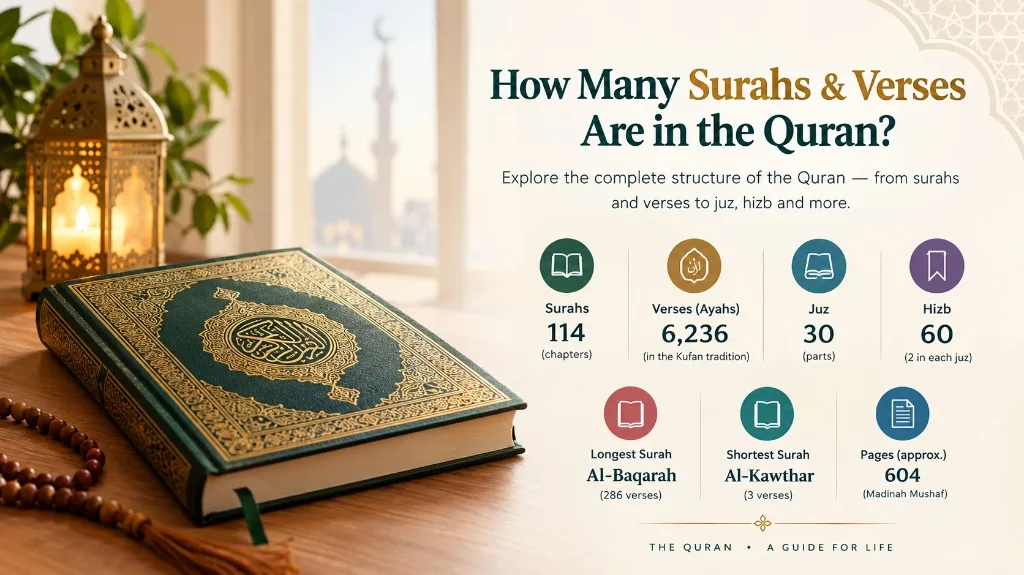
A Mushaf is organized into 114 surahs and verses, and the way it is divided into pages varies by edition. If you want to see how those structures work, see how many surahs and verses are in the Quran and how Quran pages and Mushaf layouts work.
What Do Early Quran Manuscripts Tell Us?
Early manuscripts are one kind of evidence that historians use to study how the Quran was transmitted. They are separate from the traditional account above and cannot, on their own, prove or disprove matters of faith.
One often-cited example is the Birmingham Quran manuscript, held by the University of Birmingham. It consists of two parchment leaves with parts of Surahs 18 to 20 written in an early Arabic script known as Hijazi. Radiocarbon analysis carried out by the University of Oxford dated the parchment to between 568 and 645 CE, with a 95.4% probability. This date applies to the parchment itself, not directly to the moment when the Quranic text was written on it.
Two further cautions apply. Scholars continue to discuss how best to interpret such results, and a single manuscript is one piece of evidence, not a complete answer to every historical question. Manuscript studies is a specialized field, and this article only notes that early manuscripts exist and are studied.
Reading the Quran for Yourself
Knowing how the Quran was revealed, preserved, and copied often leads learners to want to read it themselves. Bright Quran Online offers live one-to-one Quran reading classes for learners who want to build fluency with guidance.
Frequently Asked Questions
Detailed answers based on authentic Islamic scholarly references
Ready to Deepen Your Quranic Recitation?
Join our live 1-on-1 Quran and Tajweed classes designed for kids and adults at your preferred timings.
Book Free Trial ClassRecommended Reading
Continue exploring authentic guides and insights