How to Pray Salah: A Complete Step-by-Step Guide for Beginners

Bright Quran Editorial Team
Authentic Islamic & Quranic Education
Salah is the Islamic prayer. Muslims perform five obligatory prayers every day, and each one has a set number of Fard (obligatory) rak'ahs. A practical way to learn is to first understand one complete rak'ah (a cycle of standing, bowing, and two prostrations), then put two rak'ahs together into a full prayer, and then see how the three- and four-rak'ah prayers build on that same structure.
The basic structure of Salah is shared across the Sunni schools of thought (madhhabs). Some details differ, such as hand placement and certain recitation rules. This guide follows the Hanafi method wherever the schools differ and labels those details clearly. It is educational content, not a fatwa.
What Is Salah?
Salah (also written Salat) is the formal Islamic prayer. Namaz is the word for it used in Urdu, Persian, and Turkish, and by many Muslims of South Asian background. They all refer to the same prayer.
Salah is one of the five pillars of Islam and an obligatory act of worship for Muslims. Muslims pray five times a day as a regular act of worship, remembrance, and connection with Allah, spread across the day instead of being confined to one moment.
A rak'ah is one unit of the prayer. It includes standing and reciting, bowing (ruku), and two prostrations (sajdah). Every prayer is made up of two, three, or four rak'ahs.
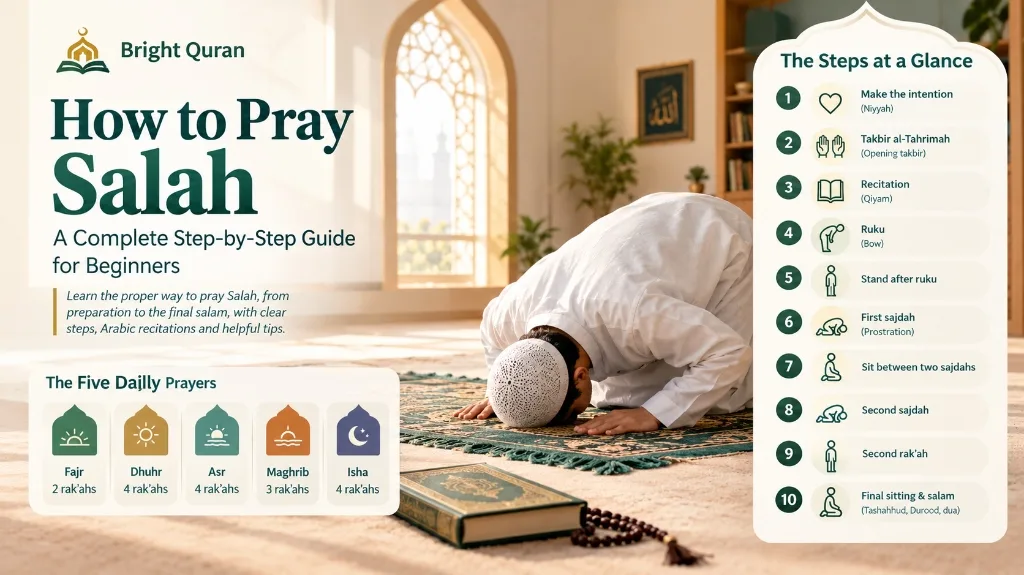
The Five Daily Prayers and Their Fard Rak'ahs
| Prayer | General time of day | Fard rak'ahs |
|---|---|---|
| Fajr | Dawn, until sunrise | 2 |
| Dhuhr | After midday | 4 |
| Asr | Afternoon | 4 |
| Maghrib | Just after sunset | 3 |
| Isha | Night | 4 |
These are the Fard rak'ahs only, the obligatory core of each prayer. Additional Sunnah and Nafl prayers, and the Witr prayer after Isha, have their own rulings. In the Hanafi school, Witr is a three-rak'ah Wajib prayer, a rank just below Fard. These can wait until the core structure feels comfortable.
On Fridays, men attend the congregational Jumu'ah prayer, which has two Fard rak'ahs, in place of Dhuhr.
What You Need Before Starting Salah
Before praying, a few preparations need to be in place:
- Purification. You need to be in a state of ritual purity before Salah. In most situations this means having Wudu, the ritual washing. Depending on the circumstances, Islamic law also provides other forms of purification, such as the full ritual bath (Ghusl) where it is required. Wudu has its own steps, and a teacher can show you how to do it in person.
- Clean body, clothes, and place. Where you pray should be free from impurity.
- Covering the awrah (satr). The required covering differs for men and women, and the schools have detailed rulings on it. In the Hanafi school, a man covers the area from below the navel to the knees (including the knees), and a woman covers her whole body except the face, hands, and feet. Clothing should be thick enough not to show the skin beneath. If you are unsure about the exact requirements, ask a qualified Hanafi teacher or scholar.
- Prayer time. Each prayer must be offered within its time. Use a local prayer timetable. Some timetables list the start of Asr separately for the Hanafi and other calculations, so check which one yours uses.
- Facing the Qiblah. Face the direction of the Kaaba in Makkah.
- Intention (niyyah). Decide in your heart which prayer you are about to perform.
How to Pray Salah Step by Step
The steps below describe a two-rak'ah prayer, such as the Fard of Fajr, following the Hanafi method as taught for men. Women's differences are explained in a later section. Prayers with three or four rak'ahs build on this same pattern.
Step 1: Make the intention (niyyah)
Stand facing the Qiblah with your feet parallel and a small natural gap between them, and keep your eyes on the spot where your forehead will rest in sajdah.
The intention belongs in the heart: you know which prayer you are about to pray. No particular Arabic sentence is required, and saying it aloud is not necessary. Hanafi references mention that quietly stating it, in any language, is preferable but not required. For example: "I intend to pray two rak'ahs of the Fard of Fajr for Allah." If you are praying behind an imam, you also intend to follow him.
Step 2: Opening takbir (Takbir al-Tahrimah)
Raise both hands, and say Allahu Akbar (God is the Greatest). This takbir begins the prayer.
In the Hanafi method, men raise their hands until the thumbs touch the earlobes, with palms facing the Qiblah. They then fold the hands below the navel, placing the right hand over the left in the Hanafi manner. Hanafi men raise their hands in this way only at the opening takbir, and not again at ruku or when rising from it.
اللَّهُ أَكْبَرُ
Allahu Akbar
"Allah is the Greatest."
Step 3: Standing (Qiyam) and recitation
Standing with hands folded, recite the following in order. In the first rak'ah you recite the Thana, Ta'awwudh, and Bismillah quietly before Al-Fatihah. You should be able to hear your own voice, but you do not need to be loud.
Thana (opening supplication)
سُبْحَانَكَ اللّٰهُمَّ وَبِحَمْدِكَ وَتَبَارَكَ اسْمُكَ وَتَعَالٰى جَدُّكَ وَلَا اِلٰهَ غَيْرُكَ
Subhanakal-lahumma wa bihamdika, wa tabarakasmuka, wa ta'ala jadduka, wa la ilaha ghayruk.
"Glory be to You, O Allah, and praise is Yours. Blessed is Your name, exalted is Your majesty, and there is no god but You."
Ta'awwudh (seeking refuge)
أَعُوذُ بِاللَّهِ مِنَ الشَّيْطَانِ الرَّجِيمِ
A'udhu billahi minash-shaytanir-rajim.
"I seek refuge in Allah from the accursed Satan."
Bismillah
بِسْمِ اللَّهِ الرَّحْمَٰنِ الرَّحِيمِ
Bismillahir-Rahmanir-Rahim.
"In the name of Allah, the Most Gracious, the Most Merciful."
Surah Al-Fatihah
| Arabic | Transliteration | Meaning |
|---|---|---|
| الْحَمْدُ لِلَّهِ رَبِّ الْعَالَمِينَ | Al-hamdu lillahi Rabbil-'alamin | All praise is for Allah, Lord of all the worlds. |
| الرَّحْمَٰنِ الرَّحِيمِ | Ar-Rahmanir-Rahim | The Most Gracious, the Most Merciful. |
| مَالِكِ يَوْمِ الدِّينِ | Maliki yawmid-din | Master of the Day of Judgment. |
| إِيَّاكَ نَعْبُدُ وَإِيَّاكَ نَسْتَعِينُ | Iyyaka na'budu wa iyyaka nasta'in | You alone we worship, and You alone we ask for help. |
| اهْدِنَا الصِّرَاطَ الْمُسْتَقِيمَ | Ihdinas-siratal-mustaqim | Guide us to the straight path, |
| صِرَاطَ الَّذِينَ أَنْعَمْتَ عَلَيْهِمْ غَيْرِ الْمَغْضُوبِ عَلَيْهِمْ وَلَا الضَّالِّينَ | Siratal-ladhina an'amta 'alayhim, ghayril-maghdubi 'alayhim wa lad-dallin | the path of those You have favored, not of those who earned Your anger, nor of those who went astray. |
After Al-Fatihah, say Ameen quietly. The Hanafi method then adds a further recitation: a surah, or at least three short verses (or one long verse). A short surah such as Al-Ikhlas is a common first choice for beginners.
Surah Al-Ikhlas (example)
| Arabic | Transliteration | Meaning |
|---|---|---|
| قُلْ هُوَ اللَّهُ أَحَدٌ | Qul huwa Allahu ahad | Say: He is Allah, the One. |
| اللَّهُ الصَّمَدُ | Allahus-samad | Allah, the Eternal Refuge. |
| لَمْ يَلِدْ وَلَمْ يُولَدْ | Lam yalid wa lam yulad | He neither begets nor was He begotten. |
| وَلَمْ يَكُن لَّهُ كُفُوًا أَحَدٌ | Wa lam yakun lahu kufuwan ahad | And there is none comparable to Him. |
Step 4: Ruku (bowing)
Say Allahu Akbar and bow, placing your hands on your knees. In the Hanafi method, men spread their fingers, keep the back straight, and hold the head level with the back. Recite at least three times:
سُبْحَانَ رَبِّيَ الْعَظِيمِ
Subhana Rabbiyal-'Azim.
"Glory be to my Lord, the Most Great."
Step 5: Standing after ruku (qawmah)
Rise saying:
سَمِعَ اللَّهُ لِمَنْ حَمِدَهُ
Sami'Allahu liman hamidah.
"Allah hears the one who praises Him."
Stand fully upright, with your arms at your sides. When praying alone, also say:
رَبَّنَا لَكَ الْحَمْدُ
Rabbana lakal-hamd.
"Our Lord, all praise is Yours."
Some texts add "wa" or "Allahumma" to this phrase. All are accepted wordings. In congregation, the imam says the first phrase and the followers say the second.
The pause is important. Hanafi references treat standing upright after ruku, and staying in each posture for about the time it takes to say "Subhanallah" once, as required parts of the prayer. Rushing through them is one of the most common beginner mistakes.
Step 6: First sajdah (prostration)
Say Allahu Akbar and go down into sajdah. The Hanafi Sunnah order is knees first, then hands, then nose, then forehead. Your face rests between your hands, with the fingers pointing toward the Qiblah. Keep your toes on the ground, pointing toward the Qiblah, and settle into the position rather than rushing it.
In the Hanafi method, men keep the arms away from the sides and the stomach away from the thighs, and do not rest the forearms on the ground. (In a congregational row, keep the arms close to the body so you do not disturb the person beside you.) Recite at least three times:
سُبْحَانَ رَبِّيَ الْأَعْلَىٰ
Subhana Rabbiyal-A'la.
"Glory be to my Lord, the Most High."
Step 7: Sitting between the two sajdahs (jalsah)
Say Allahu Akbar and sit up straight. In the Hanafi method, men sit on the left foot, laid flat, with the right foot upright and its toes pointing toward the Qiblah. The hands rest on the thighs. Pause briefly before going down again. Do not rush from one sajdah into the next.
Step 8: Second sajdah
Say Allahu Akbar and make the second sajdah exactly as the first, again reciting *Subhana Rabbiyal-A'la* at least three times.
That completes one rak'ah. To stand for the next, say Allahu Akbar and rise in a controlled way, ideally supporting yourself on your toes with your hands on your knees. Place your hands on the ground only if you need to, for example because of weakness or injury. Establish the standing position before you begin reciting.
Step 9: The second rak'ah
The second rak'ah follows the same pattern, with one difference at the start. You do not repeat the Thana or the Ta'awwudh. Begin directly with Bismillah, then Al-Fatihah, then a surah, and continue with ruku, qawmah, and the two sajdahs exactly as before.
Step 10: Final sitting (Qa'dah) and completing the prayer
After the second sajdah of the second rak'ah, say Allahu Akbar and sit as in jalsah, with the hands on the thighs. In this final sitting, recite the following in order.
Tashahhud (At-Tahiyyat)
اَلتَّحِيَّاتُ لِلّٰهِ وَالصَّلَوٰتُ وَالطَّيِّبَاتُ، اَلسَّلَامُ عَلَيْكَ اَيُّهَا النَّبِيُّ وَرَحْمَةُ اللّٰهِ وَبَرَكَاتُهٗ، اَلسَّلَامُ عَلَيْنَا وَعَلٰى عِبَادِ اللّٰهِ الصّٰلِحِيْنَ، اَشْهَدُ اَنْ لَّا اِلٰهَ اِلَّا اللّٰهُ وَاَشْهَدُ اَنَّ مُحَمَّدًا عَبْدُهٗ وَرَسُوْلُهٗ
At-tahiyyatu lillahi was-salawatu wat-tayyibat. As-salamu 'alayka ayyuhan-nabiyyu wa rahmatullahi wa barakatuh. As-salamu 'alayna wa 'ala 'ibadillahis-salihin. Ash-hadu al-la ilaha illallahu wa ash-hadu anna Muhammadan 'abduhu wa rasuluh.
"All greetings, prayers, and good words are for Allah. Peace be upon you, O Prophet, and the mercy of Allah and His blessings. Peace be upon us and upon the righteous servants of Allah. I bear witness that there is no god but Allah, and I bear witness that Muhammad is His servant and Messenger."
Durood Ibrahim (blessings on the Prophet ﷺ)
اللَّهُمَّ صَلِّ عَلَى مُحَمَّدٍ وَعَلَى آلِ مُحَمَّدٍ كَمَا صَلَّيْتَ عَلَى إِبْرَاهِيمَ وَعَلَى آلِ إِبْرَاهِيمَ إِنَّكَ حَمِيدٌ مَجِيدٌ، اللَّهُمَّ بَارِكْ عَلَى مُحَمَّدٍ وَعَلَى آلِ مُحَمَّدٍ كَمَا بَارَكْتَ عَلَى إِبْرَاهِيمَ وَعَلَى آلِ إِبْرَاهِيمَ إِنَّكَ حَمِيدٌ مَجِيدٌ
Allahumma salli 'ala Muhammadin wa 'ala ali Muhammad, kama sallayta 'ala Ibrahima wa 'ala ali Ibrahim, innaka Hamidun Majid. Allahumma barik 'ala Muhammadin wa 'ala ali Muhammad, kama barakta 'ala Ibrahima wa 'ala ali Ibrahim, innaka Hamidun Majid.
"O Allah, send blessings upon Muhammad and the family of Muhammad, as You sent blessings upon Ibrahim and the family of Ibrahim. You are Praiseworthy, Glorious. O Allah, bless Muhammad and the family of Muhammad, as You blessed Ibrahim and the family of Ibrahim. You are Praiseworthy, Glorious."
A dua
Then recite a supplication taken from the Quran or the Sunnah. A common one for beginners comes from Surah Al-Baqarah (2:201):
رَبَّنَا آتِنَا فِي الدُّنْيَا حَسَنَةً وَفِي الْآخِرَةِ حَسَنَةً وَقِنَا عَذَابَ النَّارِ
Rabbana atina fid-dunya hasanatan wa fil-akhirati hasanatan wa qina 'adhaban-nar.
"Our Lord, give us good in this world and good in the Hereafter, and protect us from the punishment of the Fire."
Salam (ending the prayer)
Turn your face to the right and say, then turn to the left and repeat:
اَلسَّلَامُ عَلَيْكُمْ وَرَحْمَةُ اللّٰهِ
As-salamu 'alaykum wa rahmatullah.
"Peace be upon you and the mercy of Allah."
That completes a two-rak'ah prayer.
How Do 3-Rak'ah and 4-Rak'ah Prayers Work?
Once the two-rak'ah pattern is familiar, longer prayers only add rak'ahs to it. This is the Hanafi method for Fard prayers:
| Prayer | Rak'ahs | After the 2nd rak'ah | 3rd and 4th rak'ahs |
|---|---|---|---|
| Fajr | 2 | Final sitting: Tashahhud, Durood, dua, salam | None |
| Maghrib | 3 | Sit for the Tashahhud only, then stand | 3rd rak'ah: final sitting and salam |
| Dhuhr, Asr, Isha | 4 | Sit for the Tashahhud only, then stand | 3rd and 4th rak'ahs, then final sitting and salam |
In practice:
- First sitting (after two rak'ahs). Recite only the Tashahhud, with nothing added after it, then say *Allahu Akbar* and stand up.
- Third and fourth rak'ahs of a Fard prayer. In the Hanafi method, recite Bismillah and Al-Fatihah, without adding another surah after it. Then continue with ruku, qawmah, and the two sajdahs.
- Final sitting. Recite the Tashahhud, Durood Ibrahim, a dua, and then the salam.
- Sunnah and Nafl prayers. In the Hanafi method, a surah is added after Al-Fatihah in every rak'ah of a Sunnah or Nafl prayer. This differs from the Fard pattern above, so learn it after the Fard prayers feel comfortable.
The Hanafi Method of Salah
This guide follows the Hanafi method for details where the schools differ. The recognized Sunni schools share the fundamental structure of Salah: the opening takbir, standing and recitation, bowing, prostration, sitting, and the closing salam.
Some details are handled differently, and they can confuse beginners who watch videos from different traditions:
- Raising the hands. In the Hanafi method described in this guide, men raise their hands for the opening takbir and do not repeat this hand-raising at ruku or when rising from it. Other recognized schools have different practices.
- Hand placement. The exact placement of the folded hands differs between schools. Hanafi men fold them below the navel.
- Recitation behind an imam. Schools differ on whether followers recite Al-Fatihah during congregational prayers. In the Hanafi school, the follower listens silently.
- Opening supplication and postures. The choice of opening supplication and some sitting postures also differ.
These differences do not mean other methods are invalid. They reflect different established readings of the sources. A beginner should follow one method consistently under the guidance of a teacher, rather than combining details from several.
Does the Method of Salah Differ for Men and Women?
In the Hanafi school, the structure, recitations, and number of rak'ahs are the same for men and women. Classical Hanafi texts describe some differences in posture and positioning. The following points summarize the Hanafi approach used in this guide:
- Opening takbir. Women raise the hands to shoulder height, covered by their clothing.
- Hands. Women place the hands on the chest, the right over the left.
- Ruku. Women bow only slightly, enough for the hands to reach the knees, with the fingers together.
- Sajdah. Women keep the arms against the sides and the stomach against the thighs.
- Sitting. Women sit on the left hip, with both feet drawn out to the right side.
Schools differ on how much the posture varies between men and women, so these details are Hanafi-specific. If you pray in a different tradition, your teacher can explain it.
Common Mistakes Beginners Make in Salah
Everyone makes these mistakes at first. They are part of learning.
- Rushing through ruku and sajdah. Allow yourself to settle briefly in ruku and in sajdah instead of dropping into them and coming straight back up. These pauses are an important part of performing the prayer properly.
- Not pausing between positions. Going straight from one sajdah to the next without sitting up is common. Sit up properly each time.
- Pronouncing Arabic inaccurately. Some Arabic letters have no English equivalent and take practice. A teacher can correct pronunciation as you learn. Tajweed classes can help with this.
- Trying to memorize everything at once. You do not need every dua before you start. Learn the essentials first (see below).
- Focusing on optional details before the essentials. Finger positions and extra supplications can wait until the basic sequence feels natural.
- Changing methods based on random online videos. Videos from different traditions teach different details. Pick one method and stay with it.
- Being afraid to ask. Many adults avoid asking questions because of embarrassment. A qualified teacher is there for exactly this.
What Should a Beginner Learn First?
You do not need to learn everything before you begin. A simple order works well, and there is no fixed time for each stage. Move on when you feel ready.
- Stage 1: Preparation
- Wudu
- Preparing for prayer (clean place, Qiblah, covering the awrah)
- The Fard rak'ahs of the five prayers
- Stage 2: The core recitations
- *Allahu Akbar*
- Surah Al-Fatihah
- A short surah, such as Al-Ikhlas
- The ruku and sajdah recitations
If reading Arabic is still new to you, Quran reading classes can help you build the foundation for Al-Fatihah and the short surahs.
- Stage 3: A complete two-rak'ah prayer
- The Tashahhud
- Durood Ibrahim
- A final dua
- Putting it all together as a full two-rak'ah prayer
- Stage 4: Longer prayers and more
- Three- and four-rak'ah prayers
- Sunnah prayers
- Witr
- Congregational details
When Should You Ask a Qualified Teacher?
Reading a guide is a good start, but a few situations call for a teacher:
- You are unsure whether you are performing a position correctly.
- Your Arabic pronunciation needs correction.
- You have a physical limitation that makes standing, bowing, or sitting difficult.
- You have a specific personal question, such as about travel, illness, or a missed prayer.
This guide is general education. For personal or complex religious questions, please consult a qualified scholar or mufti.
Learn Salah With a Teacher
A written guide can explain the sequence, but a teacher can listen to your recitation, correct your pronunciation, talk you through each posture, and answer questions about the method you are following.
Bright Quran Online offers live one-to-one online Islamic Studies classes for adults that cover the practical method of Salah, Wudu, and daily Duas following the Hanafi approach, with explanations available in English or Urdu. The first class is free, with no obligation. The academy provides general Islamic education and does not issue fatwas.
Frequently Asked Questions
Detailed answers based on authentic Islamic scholarly references
Ready to Deepen Your Quranic Recitation?
Join our live 1-on-1 Quran and Tajweed classes designed for kids and adults at your preferred timings.
Book Free Trial ClassRecommended Reading
Continue exploring authentic guides and insights