How Many Surahs & Verses Are in the Quran?

Bright Quran Editorial Team
Authentic Islamic & Quranic Education
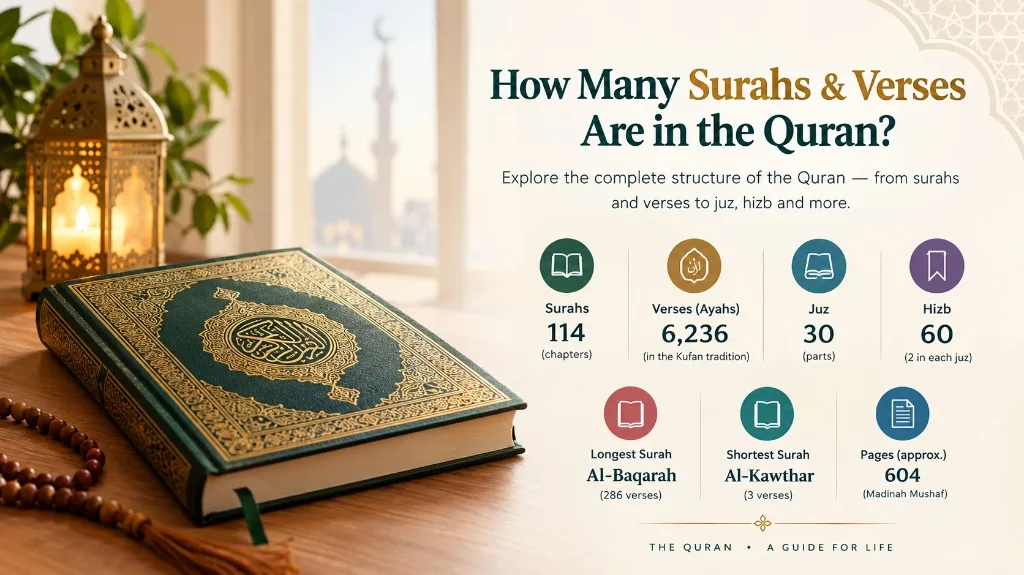
The Quran has 114 surahs (chapters). Its verses, called ayahs, are commonly counted as 6,236 according to the Kufan counting tradition, which is the numbering reflected in most printed copies that follow the Hafs reading. Other classical counting traditions place a few verse boundaries differently, so you may see slightly different totals in some books and websites. Those differences affect how verses are numbered, not the words of the Quran.
The Quran at a Glance
| Feature | Number / Detail |
|---|---|
| Surahs (chapters) | 114 |
| Ayahs (verses) | 6,236 in the Kufan counting tradition |
| Juz (parts) | 30 |
| Hizb | 60 |
| Pages | About 604 in the commonly used Madinah Mushaf; varies by edition |
| Longest surah | Al-Baqarah, 286 verses |
| Shortest surahs by verse count | Al-Asr, Al-Kawthar, and An-Nasr, 3 verses each |
| First surah in the Mushaf | Al-Fatihah |
| Last surah in the Mushaf | An-Nas |
How Many Surahs Are in the Quran?
There are 114 surahs in the Quran (*al-Quran*, "the recitation"), from Al-Fatihah to An-Nas.
A surah is a named division of the Quran, and English translations usually call it a chapter. Surahs differ enormously in size:
- Al-Kawthar has 3 verses.
- Al-Ikhlas has 4 verses.
- Al-Falaq has 5 verses.
- An-Nas has 6 verses.
- Al-Baqarah has 286 verses.
Each surah has its own name, usually taken from a word or theme within it, such as Al-Baqarah ("The Cow"). Every surah except At-Tawbah (Surah 9) opens with the Bismillah, the phrase *Bismillah ir-Rahman ir-Rahim* ("In the name of Allah, the Most Gracious, the Most Merciful"). Scholars of the Quranic sciences call this phrase the Basmalah, and the term is used in the rest of this article.
How Many Verses Are in the Quran?
An ayah (plural *ayat*) is a verse of the Quran. The Arabic word literally means "sign."
The most widely cited total is 6,236 verses, the number given by the Kufan counting tradition. This is the numbering found in most printed copies that use the Hafs reading. In this count, the Basmalah is numbered as a verse only in Al-Fatihah, where it is verse 1. It is not numbered at the start of other surahs.
Verses are referenced by surah number and verse number. For example, 2:255 means Surah 2 (Al-Baqarah), verse 255. This format makes it easy to find any passage in a printed copy, a translation, or a lesson.
You may also come across the figure 6,666 online. It is a popular round number, but it does not match the numbering of commonly printed copies or of the recognized classical counting systems.
Why Do Verse Counts Differ in Some Sources?
Early scholars of the Quranic sciences recorded several verse-counting systems, each linked to a major center of Quranic learning. Seven are commonly listed: two from Madinah, and one each from Makkah, Damascus, Hims, Basrah, and Kufah. Their totals all fall in the 6,200s, but they do not agree on every verse boundary.
The differences come down to a few specific questions:
- Where a verse ends. In some passages, one system counts a stretch of text as one verse, while another counts it as two.
- Opening letters. Some surahs begin with disconnected letters, such as *Ha Mim*. Some systems count these as a verse of their own, while others join them to what follows.
- The Basmalah. Systems differ on whether the Basmalah in Al-Fatihah counts as its own verse. Al-Fatihah has seven verses in all the standard systems, but the divisions fall in slightly different places.
What differs is the numbering, not the text. The same words are recited and written in every case, so a different total does not mean a different Quran.
The difference matters most when you look up references. If a verse number in a book, website, or app seems off by one or two, the source may follow a different counting system. This is more likely with copies prepared for other recitations (*qira'at*) than with the common Hafs print.
How Many Chapters Are in the Quran?
The same number: 114. "Chapter" is the usual English word for a surah, so "How many chapters are in the Quran?" and "How many surahs are in the Quran?" have the same answer. Many Muslim writers keep the word "surah" in English because the Quran's divisions are not arranged like the chapters of a typical book, with one topic or story after another.
How Are the Surahs Organized?
The Quran is arranged in the Mushaf order that Muslims have recited and copied for centuries, beginning with Al-Fatihah and ending with An-Nas.
Two points are worth understanding:
- It is not strictly ordered by length. Broadly, the longest surahs, such as Al-Baqarah, Al-Imran, and Al-A'raf, appear in the first part of the Mushaf, and many short surahs appear near the end. But Al-Fatihah is short and comes first, so the pattern has exceptions.
- It is not the order of revelation. Al-Baqarah is the second surah in the book but was revealed in Madinah, while many of the earliest-revealed surahs are short and appear near the end.
Keeping these two ideas separate helps when you read about when and why a surah was revealed.
What Are the Longest and Shortest Surahs?
Length can be measured in verses, words, or letters. These measures agree at the extremes, but not always.
Longest surahs by verse count:
| Rank | Surah | Verses |
|---|---|---|
| 1 | Al-Baqarah (2) | 286 |
| 2 | Ash-Shu'ara (26) | 227 |
| 3 | Al-A'raf (7) | 206 |
| 4 | Al-Imran (3) | 200 |
Al-Baqarah also contains the longest single verse in the Quran, 2:282, which deals with recording debts and contracts.
Shortest surahs: Three surahs have exactly three verses: Al-Asr (103), Al-Kawthar (108), and An-Nasr (110). Al-Kawthar is generally named the shortest surah because it has the fewest words and letters of the three.
So "which is the shortest surah?" can get slightly different answers depending on what is counted. Verse lengths vary, which is why the number of verses alone does not always show how long a surah is.
How Many Juz and Hizb Are in the Quran?
The Quran is divided into 30 juz (singular *juz*, meaning "part"). Each is a section of roughly equal length, created to make the Quran easier to divide for reading and memorization.
Many printed copies also divide each juz into two hizb, for 60 hizb in total.
Juz and surah divisions overlap without lining up. A juz can begin or end in the middle of a surah, and a long surah like Al-Baqarah spans several juz. A few reference points:
- Juz 1 begins at the start of Al-Fatihah.
- Juz 30, commonly called *Juz Amma*, begins with Surah An-Naba (78) and runs to the end of the Quran.
- Many Muslims read one juz a day during Ramadan to complete the Quran in the month.
How Many Pages Are in the Quran?
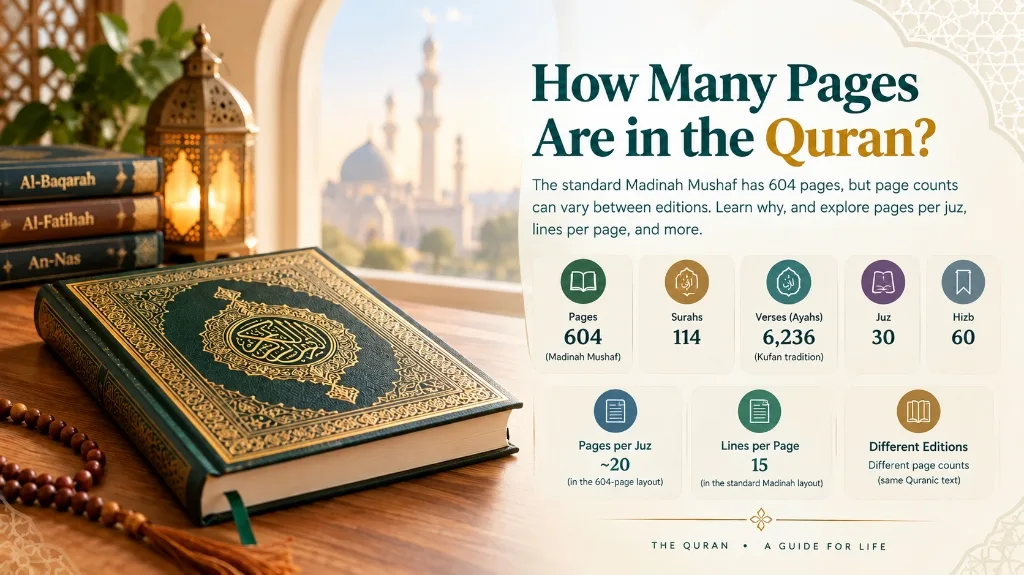
Unlike surahs and juz, the page count is not fixed. It depends on the edition: page size, font size, calligraphy, line spacing, and layout. A commonly used Madinah Mushaf has about 604 pages, but other printed editions may have more or fewer.
Why Understanding the Quran's Structure Is Useful
Knowing how the Quran is organized is more practical than it may seem.
- Finding your place. Surah and verse numbers let you follow a teacher, a translation, or a commentary that cites passages by number.
- Planning your reading. Thirty juz give a natural plan: one juz a day completes the Quran in a month, while a few pages a day take longer but keep a steady rhythm.
- Memorization. Many learners begin with short surahs from Juz 30, then work outward. It helps to track progress by surah and juz and to schedule revision alongside new memorization. A tool like our free Quran Memorization & Revision Planner can help children and beginners structure that routine.
- Study. Knowing that numbering can differ slightly between counting systems helps you avoid confusion when two sources seem to disagree by a verse.
Learning to Read the Quran With Guidance
Knowing how the Quran is organized is a useful start. Reading it fluently and with correct pronunciation is a separate skill, and it usually develops fastest with regular practice and feedback from a qualified teacher.
If you or your child would like structured support, Bright Quran Online offers live one-to-one Quran reading classes for learners building fluency, Tajweed classes for those who want to refine their pronunciation, and gentle online Quran classes for kids starting from foundational Noorani Qaida.
Frequently Asked Questions
Detailed answers based on authentic Islamic scholarly references
Ready to Deepen Your Quranic Recitation?
Join our live 1-on-1 Quran and Tajweed classes designed for kids and adults at your preferred timings.
Book Free Trial ClassRecommended Reading
Continue exploring authentic guides and insights