How Many Pages Are in the Quran? A Complete Guide

Bright Quran Editorial Team
Authentic Islamic & Quranic Education
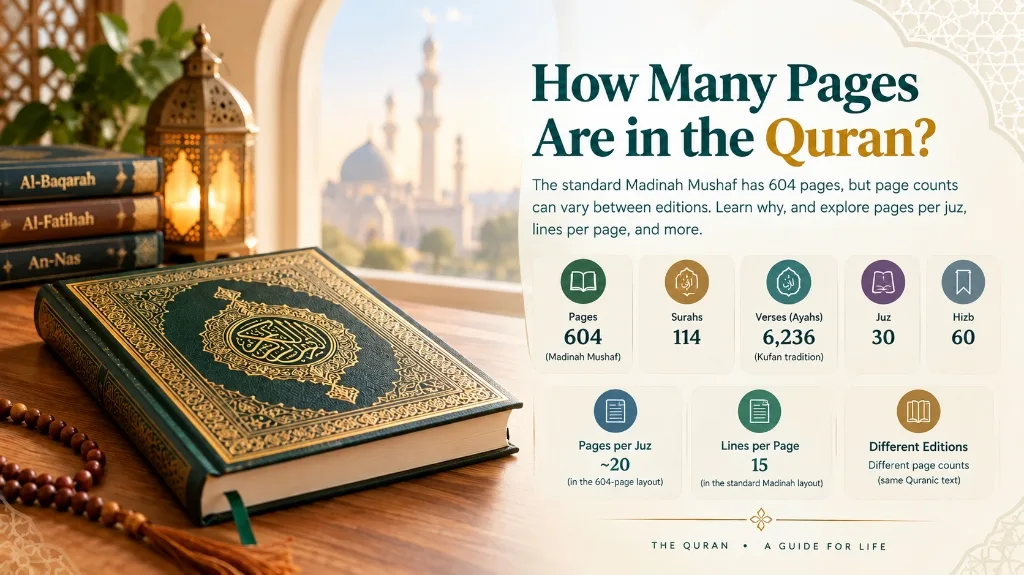
The Madinah Mushaf commonly referenced in Quran reading and memorization has 604 pages. That figure refers to a specific Mushaf layout, not to a fixed physical page count for every printed Quran. Other editions can have more or fewer pages because their script, page dimensions, line count, font size, and spacing may differ. Different Mushaf editions can arrange the Quranic text differently on the page, but a different page count does not mean that the Quranic text itself has changed.
The Quran Foundation's documentation identifies its QCF V1 and V2 Madinah layouts as 604-page Mushafs. This guide explains where the 604 figure applies, how other editions compare, and how to use page counts for reading plans and Hifz (memorization).
How Many Pages Are in the Quran?
In the Madinah Mushaf, the Quran runs from page 1 to page 604. The King Fahd Glorious Quran Printing Complex, which prepares the Madinah Mushaf, refers to its Madinah Mushaf font as having 604 pages. The Quran Foundation documents its QCF V1 and QCF V2 Madinah layouts as 604-page Mushafs, and its Pages Lookup API maps verses to pages in those layouts.
So when someone asks "How many pages are in the Quran?", the most useful answer is: 604 pages in the standard Madinah Mushaf layout. If they are using a different printed edition, however, its page count may be different.
Why Does the Quran Have 604 Pages?
Page count is a feature of how a Mushaf is typeset and printed. It is not a property of the Quranic text, and no particular number of physical pages is built into the Quran itself.
Several layout choices determine how many pages a Mushaf needs:
- Page dimensions. A larger page holds more text.
- Script and calligraphy. Different styles of Arabic writing take up different amounts of space.
- Font size. Larger lettering means fewer words per page.
- Lines per page. More lines per page means fewer pages overall.
- Spacing and layout. Margins, line spacing, and how surah headings are placed all affect the total.
Layout decisions can also affect where a page ends. The King Fahd Complex's documentation notes that it has prepared Mushafs in which pages end at the end of a verse, as well as others in which they do not. Two editions from the same publisher can therefore divide the text differently across pages.
The important distinction is that 604 is a pagination convention for a particular Mushaf layout, not a fixed number of pages assigned to the Quran itself. Once the layout is fixed, page numbers provide a consistent way to locate verses, plan reading, and track memorization. The Quran Foundation's documentation also shows that different Mushaf layouts can assign different page numbers to the same verse.
Does Every Quran Have 604 Pages?
No. A Quran does not have one universal physical page count across all Mushaf editions. Different layouts can paginate the same Quranic text differently. For example, the Quran Foundation documents 604-page QCF layouts alongside a 610-page IndoPak 15-line layout and a 548-page IndoPak 16-line layout.
Some common types of edition:
- Madinah Mushaf and related layouts. Editions that follow the 604-page Madinah pagination, including the digital layouts built on it.
- Indo-Pak editions. These vary by publisher and layout, so no single Indo-Pak page count applies.
- Large-print and pocket editions. Smaller or larger page dimensions, different font sizes, and different line spacing change how much text fits on each page, and therefore the total page count.
- Editions with translation or tafsir. These add material beyond the Arabic Quranic text, which can increase the page count.
- Digital Mushafs. Some digital Quran applications preserve the pagination of a particular Mushaf, while others may use a different layout. The Quran Foundation's documentation also notes that at larger text sizes an app may relax print line and page boundaries for readability, so on-screen pages may not match a printed copy. When page numbering matters, such as during Hifz or when following a teacher's page reference, check which Mushaf layout is selected instead of assuming that every app uses the same page numbers.
How Many Pages Are in One Juz?
The Quran is divided into 30 juz. In the 604-page Madinah Mushaf, a juz is generally around 20 pages, but the boundaries are not simply created by dividing 604 pages equally by 30. For example, Juz 1 begins on page 1 and extends to page 21, while Juz 30 runs from page 582 through page 604. The exact page span therefore varies slightly across the beginning and end of the Mushaf. Other editions will have different page spans for each juz.
How Many Pages Should You Read Each Day?
Dividing 604 pages by the number of days you want gives a quick planning figure. These are approximate calculations, not religious requirements:
| Goal | Pages per day (approx.) |
|---|---|
| Finish in 30 days | About 20 |
| Finish in 60 days | About 10 |
| Finish in 90 days | About 7 |
| Finish in 6 months | About 3 to 4 |
| Finish in 1 year | About 2 |
Twenty pages a day can be divided into smaller sessions. For example, a reader could aim for four pages after each of the five daily prayers, reaching approximately 20 pages by the end of the day. This is simply a practical planning example, not a prescribed method.
If you are still building fluency, a slower pace with careful reading is a sensible choice. A teacher can help you decide what is realistic, and structured Quran reading classes can help while you are working on accuracy.
How Many Pages Are in the Quran for Hifz?
Pages give Hifz a clear unit for planning new memorization and revision. A few points are worth keeping in mind:
- Use one Mushaf layout consistently. Page numbers and verse positions can differ between editions, so using the same Mushaf throughout a memorization program can make page-based references more consistent.
- Pages are only one unit. Some programs divide work by lines, half-pages, or verses instead, especially for beginners.
- Revision is part of the plan. Arithmetic that covers only new memorization leaves out the time needed to revise what has already been learned.
Here is simple arithmetic, shown as examples only and not as predictions: at one page a day, 604 pages is 604 days. At half a page a day it is 1,208 days. At two pages a day it is 302 days. Real progress depends on the student, their revision routine, and how consistently they study, so no fixed number of pages per day guarantees a completion date.
If your child is learning with a teacher, online Quran Hifz classes pair new memorization with revision. For self-planning tools, see these Quran memorization resources.
How Many Lines Are on a Quran Page?
The standard Madinah Mushaf layout uses 15 lines per page. This consistent layout makes page-based references particularly useful for students working with a fixed Mushaf, since a reference such as "the third line" or "the top of the page" means the same thing on every page.
Other editions can use a different number of lines. For example, the Quran Foundation documents both 15-line and 16-line IndoPak layouts. If you are using a different edition, count the lines on one page to check.
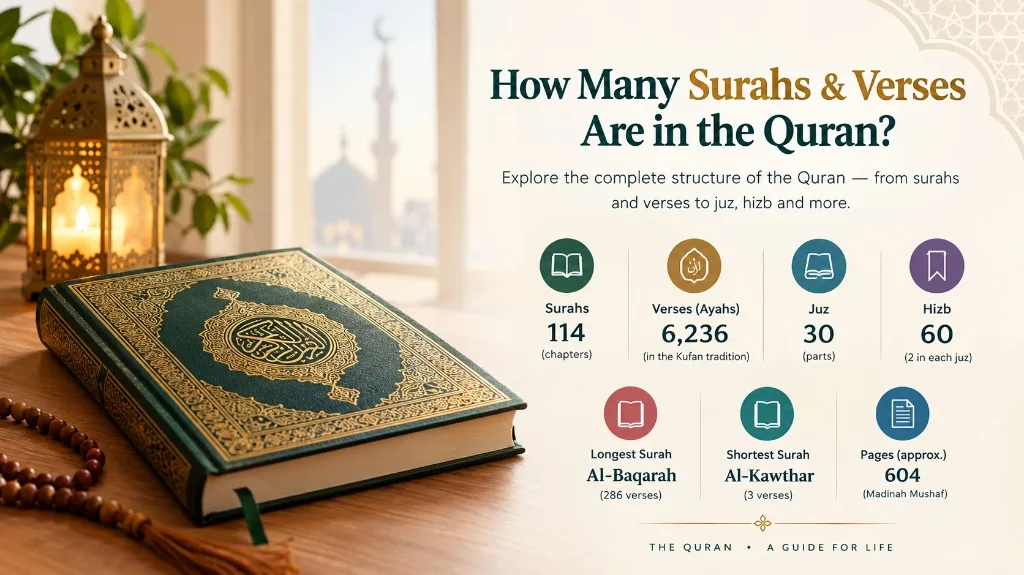
How Do Pages Relate to Surahs, Verses, and Juz?
| Division | Number / Detail |
|---|---|
| Surahs | 114 |
| Verses (ayahs) | 6,236 according to the Kufan counting tradition |
| Juz | 30 |
| Hizb | 60 |
| Pages | 604 in the standard Madinah Mushaf |
Surahs, verses, juz, and hizb are established ways of organizing the Quranic text, while page numbers belong to a particular physical or digital Mushaf layout. That is why the first four numbers remain useful across Quran study, while the page number can change from one Mushaf edition to another. For more on how verses are counted and why totals can vary, see our detailed guide on how many surahs and verses are in the Quran.
Surahs also do not take equal space. In the Quran Foundation's data for the 604-page QCF V2 layout, Al-Baqarah alone spans 48 pages, while the short surahs at the end of the Quran fit several to a page.
Why Can the Same Verse Have a Different Page Number?
Because page numbers come from the layout, not the verse. The same verse can sit on different pages in different editions.
The Quran Foundation's page-layout documentation gives a clear example. Verse 2:255 (Ayat al-Kursi) appears on page 42 in the Madinah QCF V2 layout, page 44 in a 15-line Indo-Pak layout, and page 39 in a 16-line Indo-Pak layout.
This matters in practice. If a teacher says "turn to page 42," that only works if you are both using the same edition. For this reason, verse references such as 2:255, which give the surah and verse number, are more reliable than page numbers when you are talking about a verse across different copies.
What If Your Quran Has a Different Number of Pages?
Nothing is wrong. A different page count usually just reflects a different layout.
A few practical steps:
- Check the edition. The title page or the publisher's information often names the layout.
- Use surah and verse numbers when sharing references with others, since these stay the same across editions.
- Ask your teacher which edition to use, especially for Hifz or Tajweed lessons, so that you are all working from the same layout.
- Scale your reading plan. If your edition has, say, 800 pages, divide that number by your target days instead of using 604.
Building Your Reading Skills With Guidance
Knowing the page count is useful for planning. Reading each of those pages fluently and with correct pronunciation takes practice and feedback. If you or your child would like support, Bright Quran Online offers live one-to-one lessons in Quran reading classes and Tajweed classes, and structured online Quran Hifz classes for those memorizing the Quran.
Frequently Asked Questions
Detailed answers based on authentic Islamic scholarly references
Ready to Deepen Your Quranic Recitation?
Join our live 1-on-1 Quran and Tajweed classes designed for kids and adults at your preferred timings.
Book Free Trial ClassRecommended Reading
Continue exploring authentic guides and insights