How Old Is Islam? A Clear Answer From History and the Qur'an
Bright Quran Editorial Team
Authentic Islamic & Quranic Education
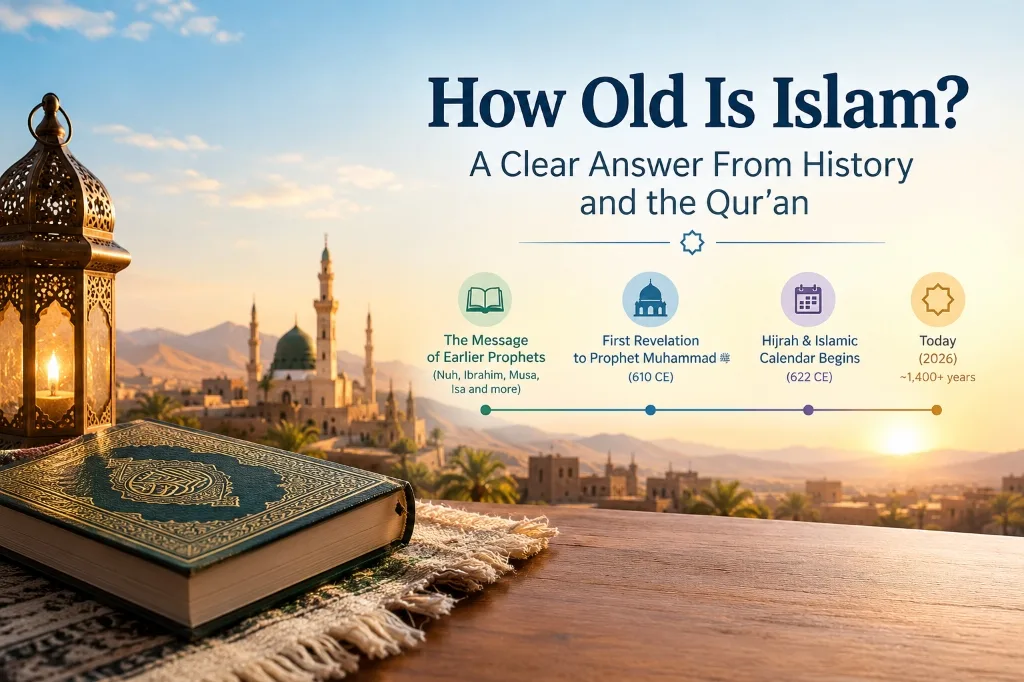
If you mean Islam as the final revealed religion brought through Prophet Muhammad ﷺ, its history goes back about 1,400 years. Muslims traditionally date the first revelation to around 610 CE, which means it began roughly 1,416 years before 2026.
But there is an important distinction. The Qur'an presents the core message of submitting to the One God as the message of earlier prophets too, including Nuh (Noah), Ibrahim (Abraham), Musa (Moses), and Isa (Jesus). So Muslims understand Muhammad ﷺ not as the founder of a completely new religion, but as the final Prophet who brought the final revelation.
This means the answer to "How old is Islam?" depends on what we mean by "Islam."
| What do you mean by "Islam"? | The answer |
|---|---|
| The final revelation and prophetic mission of Muhammad ﷺ | About 1,400 years. It began around 610 CE, roughly 1,416 years before 2026. |
| The Qur'anic idea of submission to Allah, taught by the prophets | No numerical age. The Qur'an presents it as the message of prophets throughout history, not as something that began in 610 CE. |
How Old Is Islam in 2026?
The arithmetic is simple: 2026 − 610 = 1,416. So the final prophetic mission of Islam began roughly 1,416 years ago.
It is better to say "about 1,400 years" than to treat 1,416 as an exact age, the way we would calculate a birthday. The year 610 is the traditional date of the first revelation. Encyclopaedia Britannica, for example, gives it as the year in which, according to tradition, the angel Jibril (Gabriel) عليه السلام first came to Muhammad ﷺ.
Two other numbers are often mixed up with this one: 622 (the Hijrah) and 1448 (the current Hijri year). Both are explained below.
When Did Islam Begin Historically?
In historical terms, Islam as a distinct religious community took shape in seventh-century Arabia, in the city of Makkah (Mecca), with the revelations that Muhammad ﷺ received. A few dates frame the story:
| Date | Event | What it means for "how old is Islam?" |
|---|---|---|
| c. 570 CE | Muhammad ﷺ is born in Makkah | Not the beginning of Islam. This is before revelation. |
| c. 610 CE | The first revelation comes to him, at about age 40 | The beginning of the Qur'an's revelation and of his prophetic mission |
| 622 CE | The Hijrah: migration from Makkah to Madinah | The starting point of the Islamic calendar, not of Islam itself |
| 632 CE | He dies in Madinah | The end of revelation and of his mission |
According to Quran.com's overview, the revelation came gradually over about 23 years. That is the period between 610 CE and his death in 632 CE.
What Happened in 610 CE?
The best-known account comes from Aisha رضي الله عنها, in Sahih al-Bukhari 3. She reports that revelation began with true dreams. The Prophet ﷺ then grew fond of solitude and would spend time worshipping in the cave of Hira, near Makkah.
There, the angel Jibril came to him and told him to read. The Prophet ﷺ answered that he could not. The angel pressed him, repeated the command, and then recited words that begin with "Read in the name of your Lord who created." Muslims understand these to be the opening verses of Surah Al-'Alaq (Qur'an 96).
Shaken, he returned to his wife Khadijah رضي الله عنها. She took him to her cousin Waraqa ibn Nawfal, who said that this was the same angel Allah had sent to Musa. Even at this first moment, the experience was connected to the earlier prophets.
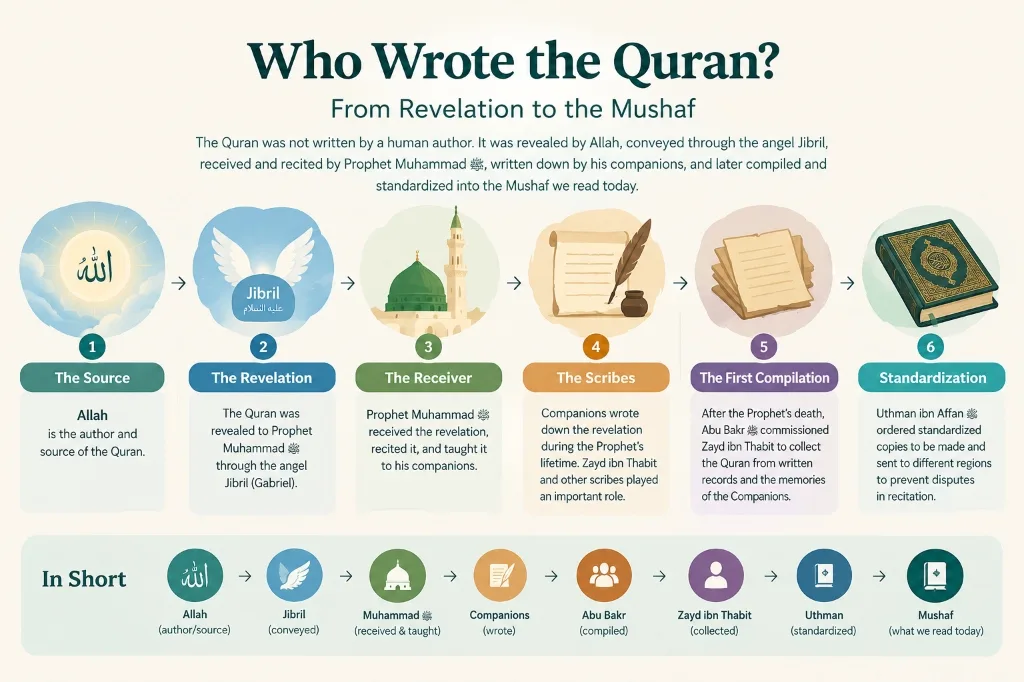
Muslims traditionally place these events in the month of Ramadan, and the date is remembered as around 610 CE. From this point, the Qur'an was revealed in parts over about two decades. To learn how those revelations were written down and later gathered into one book, see Who Wrote the Quran?.
Why Is 622 CE Important?
Many people confuse 610 CE with 622 CE. They are two different events:
- 610 CE: the first revelation to Muhammad ﷺ, the start of his prophetic mission.
- 622 CE: the Hijrah, the migration of the Prophet ﷺ and his followers from Makkah to Madinah. Encyclopaedia Britannica notes that it followed a plot against his life.
The Islamic calendar is not saying that Islam began in 622. About 17 years after the Hijrah, the second caliph, Umar ibn al-Khattab رضي الله عنه, established the Hijri calendar and chose the year of the Hijrah as its starting point. The Hijrah was remembered as a turning point, when the Muslim community became an established society in Madinah. The revelation had already been coming for over a decade.
Why does 2026 show up as 1448, not 1404? If you subtract 622 from 2026, you get about 1,404. But the Hijri year that began in mid-June 2026 is 1448 AH. The reason is that the Hijri calendar is lunar. Its year is about 354 or 355 days, roughly 11 days shorter than a solar year, so Hijri years pile up faster. The Hijri year number is therefore not the age of Islam, and it should not be calculated by simple subtraction from the Gregorian year.
Was Prophet Muhammad ﷺ the Founder of Islam?
The answer depends on whether we are speaking historically or from the Islamic theological perspective. Historians and reference works often call Muhammad ﷺ the founder of Islam. Encyclopaedia Britannica, for example, describes him as the Arab prophet who established the religion of Islam. That is a historical description of how the community and its institutions emerged in seventh-century Arabia.
Muslims understand his role differently. They do not believe he invented a new religion. They believe he was the final Prophet and Messenger, who received and conveyed the last revelation. The Qur'an describes Muhammad ﷺ as the "seal of the prophets" (Qur'an 33:40), which Muslims understand as affirming the finality of his prophethood, and Muslims understand its words that Allah has perfected the religion (5:3) as the completion of a message that earlier prophets had also brought.
This is why "Muhammad founded Islam in 610" is not how Muslims would put it. A more accurate way to say it is that the final revelation of Islam began to come to Muhammad ﷺ around 610 CE.
How Does the Qur'an Describe the Religion of Earlier Prophets?
The Qur'an repeatedly presents the core of the message, worshipping Allah alone and submitting to Him, as the same across prophets. Here are key passages, with what they mean in context. The translations below are Sahih International.
One religion, many prophets (42:13). Allah "has ordained for you of religion what He enjoined upon Noah and that which We have revealed to you, [O Muhammad], and what We enjoined upon Abraham and Moses and Jesus — to establish the religion and not be divided therein." The verse names five prophets in one breath, and it lists Muhammad ﷺ alongside the others, not apart from them. The shared religion is to be established, and not split into divisions.
Ibrahim, and the meaning of "Muslim" (3:67; 2:131–132). The word *muslim* in Arabic literally means one who submits. In 3:67, Ibrahim "was one inclining toward truth, a Muslim [submitting to Allah]." The verse sits in a passage about debates over who could claim him, and it describes him by his submission to Allah rather than by a later group name. In 2:131–132, when his Lord told him to "Submit," he said, "I have submitted [in Islam] to the Lord of the worlds." He and Ya'qub (Jacob) then urged their sons not to die "except while you are Muslims."
"The religion in the sight of Allah is Islam" (3:19). This verse is often quoted in isolation. Read alongside the verses above, it can be understood as speaking of submission to Allah, which is the religion the prophets taught, with its final form revealed to Muhammad ﷺ. Ibn Kathir, commenting on the Qur'anic narrative, writes that Islam is the religion of all the prophets from first to last, even though their laws may differ.
A shared core, but different laws (5:48). The Qur'an also says: "To each of you We prescribed a law and a method." The Prophet ﷺ is reported to have compared the prophets to brothers with one father and different mothers: their religion is one, but their laws differ (Sahih al-Bukhari 3443). Muslims therefore believe that the core message is common, while the Qur'an is the final revelation and law. This does not mean that Islam says other religions today are identical to it in every belief or practice.
Did Islam Exist Before Prophet Muhammad ﷺ?
It depends on what is meant by "Islam":
- Islam as submission to the One God, taught by the prophets: yes, according to the Qur'an. It presents this as the message of earlier prophets, not as something new in the seventh century.
- Islam as the final revelation and the community around it: no. This began with Muhammad ﷺ and the revelation of the Qur'an.
So when Muslims say "Islam is not a new religion," they mean the first sense. They are not saying that the Qur'an existed before the seventh century, and they are not saying that Muhammad ﷺ was not the final Prophet.
Some things this article does not claim. It does not give Islam a numerical age that begins with Adam عليه السلام, because the Qur'an and reliable sources do not give a date for him. Saying "Islam is 6,000 years old" would be inventing a precision that does not exist. The Qur'an presents submission to Allah as the message of prophets throughout human history, and that is as far as the evidence goes.
How Old Is Islam Compared With Christianity and Judaism?
The three can be compared on a historical timeline, with care:
| Tradition | Broad historical starting point | Note |
|---|---|---|
| Judaism | Ancient roots in the ancient Near East | Historically the oldest of the three traditions |
| Christianity | 1st century CE | Emerged in the 1st century CE in Judea |
| Islam | 7th century CE / first revelation c. 610 CE | Muslims also trace its core theological message back to earlier prophets |
Historically, Christianity predates Islam, while Judaism has much older historical roots. From the Islamic theological perspective, however, the core message of submission to Allah is traced through the earlier prophets.
So, How Old Is Islam? The Short Answer
As the final revelation, Islam is about 1,400 years old, beginning around 610 CE. As the Qur'an describes it, submission to the One God was the message of the prophets before Muhammad ﷺ, so it is not presented as a new religion invented in the seventh century.
Where to Go From Here
If learning about Islam's history has made you curious about the Qur'an itself, Bright Quran Online offers live one-to-one online Quran reading classes and online Islamic Studies classes for adults that cover practical essentials like Salah and daily duas.
Frequently Asked Questions
Detailed answers based on authentic Islamic scholarly references
Ready to Deepen Your Quranic Recitation?
Join our live 1-on-1 Quran and Tajweed classes designed for kids and adults at your preferred timings.
Book Free Trial ClassRecommended Reading
Continue exploring authentic guides and insights