How Many Sajdahs Are There in the Quran? Complete List and Locations

Bright Quran Editorial Team
Authentic Islamic & Quranic Education
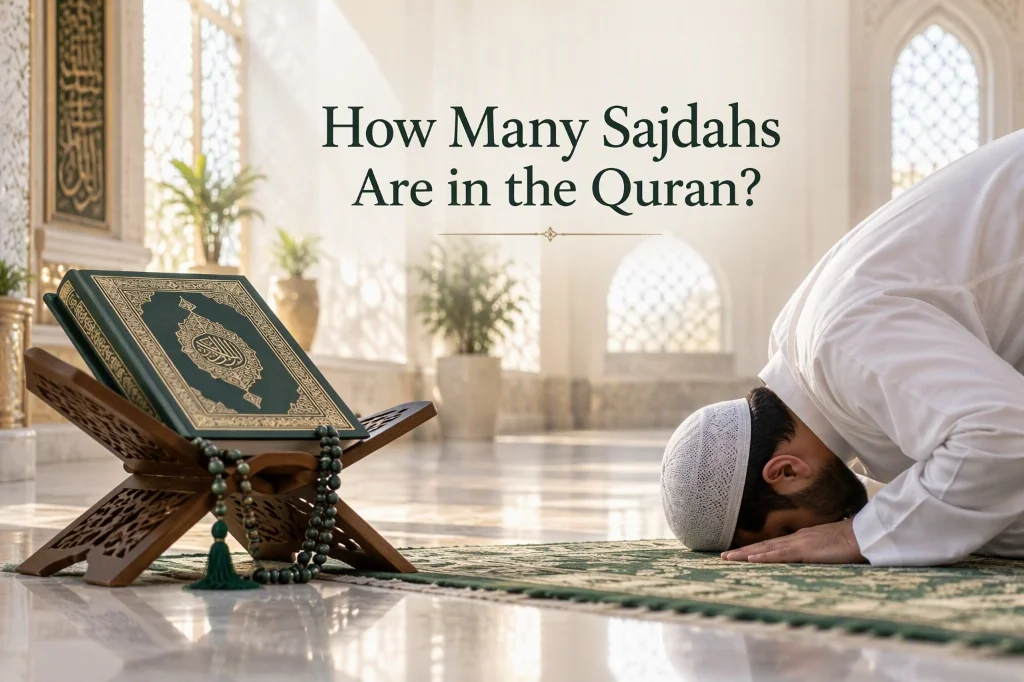
The Hanafi school counts 14 places of Sajdah Tilawah (the prostration of recitation) in the Quran, while a broader list identifies 15 commonly listed prostration locations. The difference comes from how scholars classify Surah Al-Hajj 22:77 and Surah Sad 38:24.
The Quran itself is the same in every case. The difference is one of scholarly classification, not of text. The complete list, with surah, ayah, and para (juz) numbers, is below. If you are looking for a particular sajdah, jump to the table or to the list by para.
How Many Sajdahs Are There in the Quran?
| Count | Who uses it | What it includes |
|---|---|---|
| 14 | Hanafi school | Includes Sad 38:24. Does not count the second prostration of Al-Hajj (22:77). |
| 14 | Standard Shafi'i presentation | Includes both Al-Hajj 22:18 and 22:77. Treats Sad 38:24 as a prostration of gratitude (sajdah al-shukr), not a prostration of recitation. |
| 15 | Broader reference list | Lists all 15 locations, including the two that schools classify differently. |
So "14 or 15?" has no single answer without a school attached. Two readers can both be correct, because they are following different scholarly classifications.
This is not a difference in the Quran. Every Muslim recites the same text, with the same verses and the same words. What differs is whether scholars classify a particular verse as one where the reader performs Sajdah Tilawah. That is a matter of fiqh and scholarly interpretation. It does not mean missing verses, different Arabic texts, or contradictions in the Quran.
Complete List of Sajdah Verses in the Quran
The table lists all 15 locations in the order they appear in the Quran, with the Hanafi and standard Shafi'i classifications.
| No. | Surah | Surah No. | Ayah | Juz / Para | Hanafi | Shafi'i (standard) |
|---|---|---|---|---|---|---|
| 1 | Al-A'raf | 7 | 206 | 9 | Counted | Counted |
| 2 | Ar-Ra'd | 13 | 15 | 13 | Counted | Counted |
| 3 | An-Nahl | 16 | 50 | 14 | Counted | Counted |
| 4 | Al-Isra | 17 | 109 | 15 | Counted | Counted |
| 5 | Maryam | 19 | 58 | 16 | Counted | Counted |
| 6 | Al-Hajj | 22 | 18 | 17 | Counted | Counted |
| 7 | Al-Hajj | 22 | 77 | 17 | Not counted | Counted |
| 8 | Al-Furqan | 25 | 60 | 19 | Counted | Counted |
| 9 | An-Naml | 27 | 26 | 19 | Counted | Counted |
| 10 | As-Sajdah | 32 | 15 | 21 | Counted | Counted |
| 11 | Sad | 38 | 24 | 23 | Counted | Sajdah of gratitude (shukr) |
| 12 | Fussilat (Ha Mim Sajdah) | 41 | 38* | 24 | Counted | Counted |
| 13 | An-Najm | 53 | 62 | 27 | Counted | Counted |
| 14 | Al-Inshiqaq | 84 | 21 | 30 | Counted | Counted |
| 15 | Al-Alaq | 96 | 19 | 30 | Counted | Counted |
Hanafi total: 14. Standard Shafi'i total for Sajdah Tilawah: 14. The two counts are not the same 14. They differ at rows 7 and 11.
\* Fussilat (Ha Mim Sajdah). Surah 41 is known by both names. English references commonly call it Fussilat, while many copies, especially in South Asia, title it Ha Mim Sajdah. It is a different surah from Surah As-Sajdah (32). Some references give the sajdah passage as 41:37–38, because scholars have differed on exactly where the prostration falls. The Hanafi position places it at 41:38, which ends "...and they do not tire." Al-Isra is likewise sometimes given as 17:107–109. The Hanafi lists give 17:109.
Sajdahs by Para (Juz)
This is a quick reference for readers who are working through the Quran para by para:
- Para 9: Al-A'raf (7:206)
- Para 13: Ar-Ra'd (13:15)
- Para 14: An-Nahl (16:50)
- Para 15: Al-Isra (17:109)
- Para 16: Maryam (19:58)
- Para 17: Al-Hajj (22:18; and 22:77 in the broader list)
- Para 19: Al-Furqan (25:60) and An-Naml (27:26)
- Para 21: As-Sajdah (32:15)
- Para 23: Sad (38:24)
- Para 24: Fussilat / Ha Mim Sajdah (41:38)
- Para 27: An-Najm (53:62)
- Para 30: Al-Inshiqaq (84:21) and Al-Alaq (96:19)
Why Are There 14 or 15 Sajdahs?
Most of the recognized locations are not disputed. The main differences relevant to the 14-or-15 question concern the second sajdah of Al-Hajj (22:77) and Sad (38:24).
Surah Al-Hajj 22:77
Surah Al-Hajj is the only surah where a second prostration comes up.
- Why some scholars count it: The Shafi'i school counts Al-Hajj 22:77 as a Sajdah Tilawah. This position is supported by reports of fifteen prostration locations, including two in Surah Al-Hajj, such as a narration from Amr ibn al-As رضي الله عنه. Scholars have discussed the strength of that narration, so it is best understood as evidence cited by scholars rather than as undisputed proof.
- Why the Hanafi school does not: Hanafi references, such as *Maraqi al-Falah*, do not count the second Al-Hajj location as a prostration of recitation. This is why the Hanafi count stops at 14.
Surah Sad 38:24
Here the positions are reversed.
- Why the Hanafi school counts it: The Hanafi school includes Sad 38:24 among the prostrations of recitation. The verse describes Dawud (David) عليه السلام falling down in prostration and turning to Allah in repentance. Sahih al-Bukhari 1069 records Ibn Abbas رضي الله عنهما saying that he saw the Prophet ﷺ prostrate when reciting it.
- Why the standard Shafi'i presentation does not: The same report also records Ibn Abbas saying that Sad is not among the obligatory ('azaim) prostrations. In the standard Shafi'i presentation, the prostration here is a *sajdah al-shukr*, a prostration of gratitude, rather than a prostration of recitation. Some Shafi'i scholars have taken a different view.
Neither classification denies that the Prophet ﷺ prostrated at Sad. The difference is how the prostration is classified.
What Is Sajdah Tilawah?
*Sajdah Tilawah* means the prostration of recitation. It is a prostration performed when a person recites, or hears, one of the verses of sajdah in the Quran. It is a response to the verse, an act of humility before Allah, and it is separate from the prostrations that are part of the Salah.
A few points, attributed to the schools that hold them:
- According to the Hanafi school, Sajdah Tilawah is *wajib* (obligatory) on the person who recites the verse and on the person who hears it.
- Other schools generally regard Sajdah Tilawah as Sunnah or *mustahabb* rather than wajib, although details differ between schools. Scholars of this view cite Sahih al-Bukhari 1077, in which Umar ibn al-Khattab رضي الله عنه told the people that whoever prostrates at a verse of sajdah has done well, and that there is no sin on the one who does not.
These are differences of fiqh and are not a reason to criticize anyone. Follow the school you normally follow, or ask your teacher.
How Many Sajdahs Are There According to the Hanafi School?
14. In the order of the Quran, the Hanafi locations are:
Al-A'raf 7:206, Ar-Ra'd 13:15, An-Nahl 16:50, Al-Isra 17:109, Maryam 19:58, Al-Hajj 22:18, Al-Furqan 25:60, An-Naml 27:26, As-Sajdah 32:15, Sad 38:24, Fussilat 41:38, An-Najm 53:62, Al-Inshiqaq 84:21, and Al-Alaq 96:19.
A Hanafi reader who sees a sajdah mark at Al-Hajj 22:77 in a printed copy does not count it among these 14.
What About the Shafi'i School?
It would be inaccurate to say simply "the Shafi'i school counts 15." The standard Shafi'i presentation counts 14 prostrations of recitation:
- It includes both Al-Hajj 22:18 and Al-Hajj 22:77.
- It does not count Sad 38:24 as a prostration of recitation. It is treated as a prostration of gratitude.
So both schools reach 14, but by different routes. The Hanafi 14 includes Sad and excludes the second Al-Hajj. The Shafi'i 14 includes both Al-Hajj locations and excludes Sad. The broader list of 15 combines both sets.
Which Surah Has Two Sajdahs?
Surah Al-Hajj, at 22:18 and 22:77. Whether both are treated as prostrations of recitation depends on the school, as explained above. Every other surah with a sajdah has only one.
Where Is the First Sajdah in the Quran?
Surah Al-A'raf, 7:206, in Para 9. It is the first in the order of the Quran.
Where Is the Last Sajdah in the Quran?
Surah Al-Alaq, 96:19, in Para 30. It comes in one of the shortest surahs, near the end of the Quran.
How Do You Know When a Verse Requires Sajdah?
Printed copies commonly mark sajdah locations with the symbol ۩ or with a sajdah indication in the margin. The markings can vary between editions, particularly because different schools recognize some locations differently. For a precise reference, use the surah and ayah numbers in the table above.
What Should I Do If My Quran Shows 14 but Another Quran Shows 15?
This is a common question, and the explanation is usually simple:
- Some printed copies mark all 15 commonly listed locations, including two that are treated differently by different schools.
- Some lists and books give the Hanafi 14 or the Shafi'i 14, depending on the school they follow.
- The Quran text has not changed. The lists reflect different classifications.
Follow the school or the trusted scholarly guidance you normally follow. If you are not sure which applies to you, ask a qualified teacher or scholar. Please do not make your own ruling.
Reading the Quran With Care
Knowing where the sajdah verses fall is useful, but recognizing them while reading takes familiarity with the text. If you want to read the Quran more confidently or refine your pronunciation, Bright Quran Online offers one-to-one Quran reading classes and Tajweed classes.
Frequently Asked Questions
Detailed answers based on authentic Islamic scholarly references
Ready to Deepen Your Quranic Recitation?
Join our live 1-on-1 Quran and Tajweed classes designed for kids and adults at your preferred timings.
Book Free Trial ClassRecommended Reading
Continue exploring authentic guides and insights