How Long Does It Take a Child to Learn Quran?

Bright Quran Editorial Team
Authentic Islamic & Quranic Education

If your child is learning to read the Quran, one question probably comes to mind: how long will it take before they can read independently?
There is no single timeline that applies to every child. A child who already recognises Arabic letters will generally progress differently from a beginner encountering them for the first time — and both are completely normal starting points. What actually shapes the timeline is your child's starting level, how consistently they attend and revise, and the quality of feedback they receive along the way.
Rather than fixating on how many months it "should" take, it helps to understand the stages of learning, what progress looks like at each one, and how you can support your child without putting unnecessary pressure on them. This guide walks through both.
First, What Does It Mean to Learn to Read the Quran?
When parents say their child is "learning to read the Quran," they may mean several different things. Recognising Arabic letters isn't the same as reading connected words, and reading words isn't the same as reading smoothly with correct pronunciation.
A child's learning journey usually includes several milestones:
- Recognising Arabic letters — identifying letters by their shapes and sounds, including distinguishing between similar-looking letters and recognising them whether they appear at the start, middle, or end of a word.
- Learning through Qaida — building the foundation for joining letters, reading vowel marks (harakat), and understanding basic reading rules, commonly through Noorani or Madani Qaida.
- Beginning Quran reading (Nazra) — applying those skills to actual Quranic text for the first time.
- Developing fluency and Tajweed — reading more smoothly while applying relevant Tajweed rules more consistently.
This is why two children who've both been learning for several months can be at noticeably different points — one may still be strengthening their Qaida foundation, while another is already reading from the Quran. Neither situation, by itself, says anything about whether a child is doing well. Their own progress from their own starting point matters far more than a comparison with another child.
The Main Stages of Learning to Read the Quran
Stage 1: Recognising Arabic Letters
Every child who starts from the beginning begins here: learning to recognise Arabic letters and pronounce them correctly.
Some letters look similar, so children often confuse them at first (for example, ب, ت, and ث). It's also common for a child to recognise a letter shown on its own but struggle to identify the same letter once it appears inside a word — that's a normal part of the process, not a sign of difficulty.
There's no single ideal age to begin this stage. Children develop letter-recognition readiness, attention span, and the ability to sit through a structured lesson at different rates — what matters more than age on paper is whether a child can currently engage with a lesson, which a teacher is usually better placed to judge directly than a parent guessing from age alone.
Progress here looks like recognising letters with less hesitation, confusing similar letters less often, and remembering sounds without repeated reminders. A child who already knows the alphabet may need less time at this stage; another may benefit from more revision before moving on — both are fine.
Need extra Qaida practice at home?
To support your child's progress, download our free Noorani Qaida Learning & Practice Pack. It provides structured guided exercises for beginners.
Stage 2: Learning Through Noorani or Madani Qaida
Once a child is familiar with the letters, the next step is learning how they connect and how vowel marks affect pronunciation.
A Qaida provides a structured foundation for this — commonly Noorani Qaida or Madani Qaida, depending on the child's level and the teacher's approach. During this stage, children work toward reading letter combinations, words with different vowel marks, and patterns involving rules like sukoon and shaddah.
The goal isn't to reach the final lesson as quickly as possible — it's worth resisting that temptation, since the accuracy built here tends to carry through directly into Quran reading later. A child should gradually become more accurate and confident with material already covered, not just move faster through new material.
Read more about Noorani and Madani Qaida classes
Stage 3: Beginning Quran Reading (Nazra)
Once a child has a sufficiently strong foundation, they begin applying their reading skills to the Quran itself.
This transition can be genuinely challenging. Qaida exercises introduce reading patterns in a structured, controlled way, while Quranic passages require the child to apply those skills across longer, more varied text. It's therefore common — not concerning — for a child to read more slowly when they first begin Nazra, even after making good progress through Qaida. Slower reading at this stage usually means they're adjusting to a more demanding task, not that earlier progress has been lost.
Explore online Quran reading classes for children
Stage 4: Developing Fluency and Improving Tajweed
Beginning to read from the Quran is a major milestone, but it isn't the finish line.
From here, children continue developing smoother reading, more consistent pronunciation, and a better grasp of relevant Tajweed rules — correct articulation points (makharij), elongation (madd), and others appropriate to their level. A child may read familiar passages comfortably while still needing help with unfamiliar words or specific rules, which is a normal reason to keep practising rather than a setback.
Fluency builds gradually through ongoing learning and revision — it isn't a single point every child reaches after the same number of months.
What Affects How Quickly a Child Learns?
Several factors genuinely shape pace, and most of them are things a parent can actually influence — which is more useful than fixating on a deadline or another child's progress.
The child's starting level. A child who already recognises some Arabic letters has different learning needs from a complete beginner. Previous exposure helps, though some children still benefit from revising earlier material before moving ahead confidently.
Age and individual readiness. As with Stage 1, there's no universal "right age" to start or to expect a certain pace — readiness varies by child, and a teacher assessing the child directly is better placed to judge this than age alone.
Consistency of lessons. Regular lessons help a child build on what they've already learned. Long gaps often mean spending time reviewing earlier material before new concepts can be introduced, which can look like "slow progress" but is really a consequence of inconsistency.
Short revision at home. A few minutes reviewing the teacher's assigned work between lessons helps a child return to the next class better prepared — this doesn't need to become another full lesson.
Individual feedback and correction. Children may repeat the same mistake if no one points it out. A teacher who identifies specific letters, sounds, or rules that need attention — and corrects them without making the child afraid of being wrong — helps prevent small errors from becoming harder-to-unlearn habits later.
The child's confidence and comfort. Some children read aloud easily; others hesitate when unsure. A supportive environment that gives room to make mistakes and ask questions tends to help more than correction alone. If a child seems anxious during lessons, it's worth raising with the teacher rather than assuming reluctance to learn.
Lesson pace and structure. Not every child needs the same amount of repetition. If a child repeatedly struggles with a particular lesson, revisiting the material is often more useful than pushing ahead just to finish a course on schedule.
How Can Parents Tell Whether Their Child Is Making Progress?
Progress in Quran reading is usually gradual. Judging it only by "can they read fluently yet" can mean missing real improvement happening along the way. Instead, look for smaller, observable signs:
- Recognising familiar letters with less hesitation
- Confusing similar-looking letters less often
- Reading previously covered material with fewer reminders
- Applying familiar vowel marks more accurately
- Correcting some of their own mistakes without being told
- Becoming more willing to read aloud and participate
If you're unsure, it's reasonable to ask the teacher directly:
- *"What can my child do now that they couldn't do when they started?"*
- *"Which specific letter, sound, or rule still needs the most attention?"*
- *"What should we revise at home before the next lesson?"*
A teacher who can answer these specifically — rather than with a general "they're doing fine" — is giving you something you can actually act on.
What Can Parents Do at Home Without Putting Pressure on Their Child?
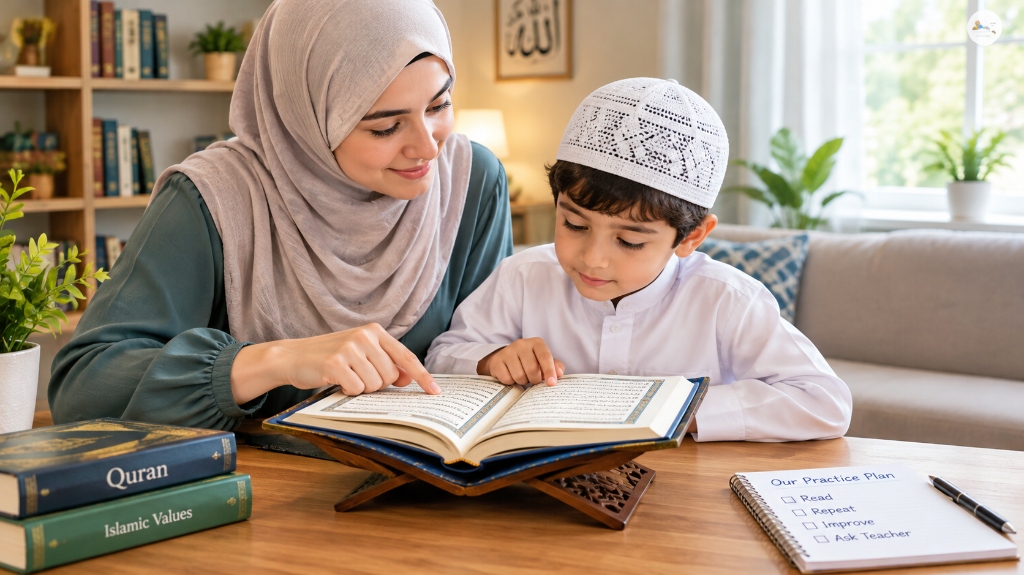
Parents don't need to become Quran teachers themselves to support progress. A few manageable habits tend to help more than long or ambitious ones:
- Keep revision short. A few minutes reviewing the teacher's assigned material is usually enough — the right amount depends on your child's age and attention span.
- Make it predictable, not lengthy. A short routine that fits naturally into the day is easier to sustain than occasional long sessions.
- Encourage effort, not just speed. Notice improvements in pronunciation, letter recognition, and confidence — not only how much material was covered.
- Avoid comparisons, even unintentional ones, with siblings or other children. Different starting points mean different paces, and that's normal.
- Communicate with the teacher if your child is repeatedly confused by the same material, rather than introducing different explanations or exercises at home that might conflict with what the teacher is building toward.
The purpose of home practice is reinforcement, not re-teaching.
When Should Parents Consider Changing the Learning Approach?
A single difficult lesson, or a slow week, doesn't mean something is wrong. But if progress stays limited over a sustained period, it's worth reviewing the situation directly with the teacher. Useful questions include:
- *"Is my child struggling with a specific letter, rule, or stage — or with consistency overall?"*
- *"Would more frequent revision help, or would a different pace suit them better?"*
- *"Is the current teaching approach keeping my child engaged?"*
Sometimes the answer is simply more time and repetition at the current stage. Other times, adjusting the pace, structure, or teaching style helps. If a child shows persistent difficulty distinguishing letters despite repeated practice, it's worth raising this with the teacher and considering whether an evaluation from a relevant educational specialist would be useful. This article isn't a substitute for that kind of assessment, and a Quran teacher isn't positioned to diagnose a learning difficulty — but they can usually tell you whether what they're seeing looks like a normal part of the learning curve or something worth looking into further.
A Realistic Next Step
If you're unsure exactly where your child currently stands, that's a completely normal position to be in — and it's usually easier to answer with a direct assessment than by guessing at home.
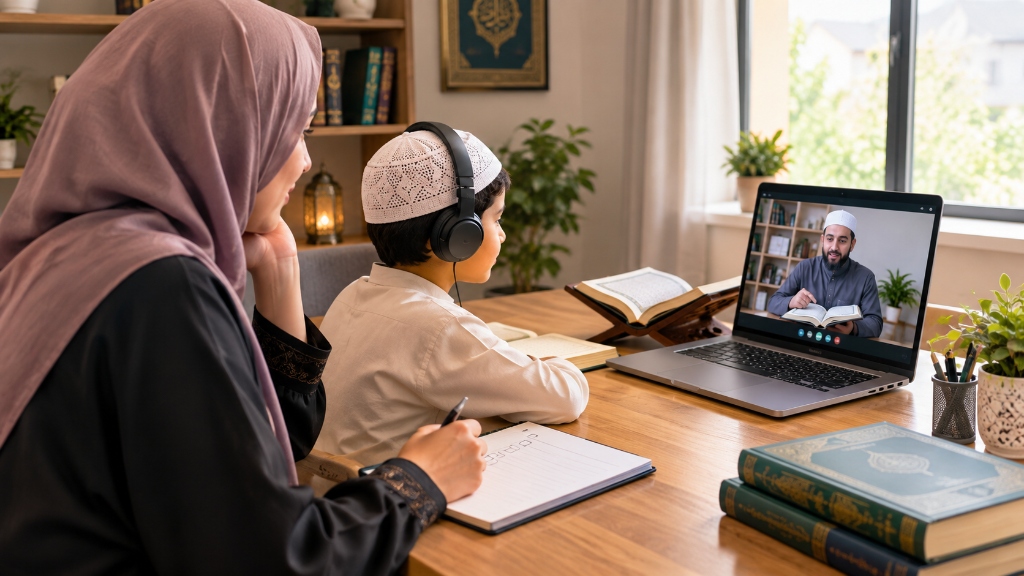
Bright Quran's online Quran classes for kids include a free first class, with no obligation, specifically to identify your child's current level before recommending a starting point — whether that's Noorani or Madani Qaida or moving straight into Quran reading (Nazra). If your child's reading has already been a source of ongoing worry, this guide for parents of a child who couldn't yet read Quran may also help.
Every child needs a starting point, a suitable pace, and time to practise. Rather than asking whether your child is learning as quickly as someone else, it's more useful to ask whether they're steadily building the skills for their next step — and that's a question a teacher watching them directly can usually answer far better than a general timeline ever could.
Frequently Asked Questions
Detailed answers based on authentic Islamic scholarly references
Ready to Deepen Your Quranic Recitation?
Join our live 1-on-1 Quran and Tajweed classes designed for kids and adults at your preferred timings.
Book Free Trial ClassRecommended Reading
Continue exploring authentic guides and insights